The best hockey skates for beginners, and the two things that decide the first hour
A hockey skate is the easier blade to learn on. It is also the one most likely to arrive in the wrong size and blunt, and both of those are avoidable before you order.
By Sawyer V. · Published
We have not tested this gear. Everything below is compiled from published specifications and published safety standards, and the arithmetic is public so you can check it. This page carries affiliate links: if you buy through one we earn a commission at no extra cost to you, and it does not change the order of the picks. Full disclosure.
The short answer
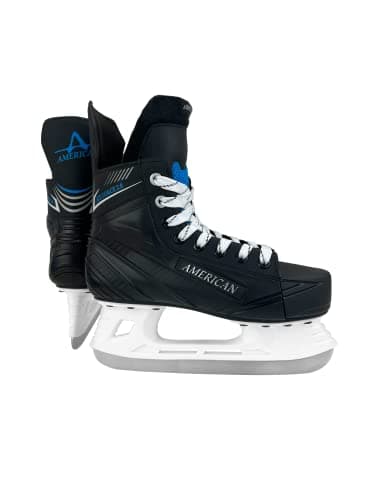
For a first hockey skate, the American Athletic Ice Force at $94.99 is the pick: American Athletic publishes it as a beginner-to-intermediate skate, with an injection-molded sidewall for ankle support and nine adult sizes from 5 to 13. Two things matter more than the model. Hockey skates are not shoe-sized unless the maker says so in writing, and none of these arrives sharpened, so budget a shop visit before the first outing.
| # | Pick | Best for | Score | Price |
|---|---|---|---|---|
| 1 | American Athletic Ice Force Hockey Skates A first hockey skate for public sessions and pond hockey | $4.75 a dayon snow | 5.8/10 | $94.99 - View on Amazon |
| 2 | American Athletic Women's Soft Boot Hockey Skates A woman who wants a hockey blade without a stiff competition boot | $5.00 a dayon snow | 5.7/10 | $99.99 - View on Amazon |
| 3 | Tour Code LX Ice Hockey Skates A beginner who intends to join a league or play pickup rather than circle a public session | $7.95 a dayon snow | 4.7/10 | $159.00 - View on Amazon |
Prices last verified November 5, 2026. Prices move constantly; the figure on Amazon at the moment you click is the real one.
The sizing rule, which is where most of these go wrong
Hockey skates have a reputation for running one to one and a half sizes smaller than your shoes. That reputation comes from performance skates, where a close fit is the point, and it is why so much skate advice begins by telling you to order down.
Follow that advice on a recreational skate and you will send it back. Entry-level skates are built on different lasts with different margins, and the only thing that actually tells you what to order is what the maker publishes about its own skate. Two of the three here publish it plainly, and the difference is worth printing:
| Skate | What the maker publishes | What to order |
|---|---|---|
| American Athletic Ice Force | ADULT sizing, with a size chart published as an image | Measure your foot and check it against their chart |
| American Athletic Women's Soft Boot | Sizing true to shoe size | Your usual shoe size |
| Tour Code LX | Fits true to men's whole sizes; choose the closest men's shoe size | Your usual men's size, rounded to a whole |
None of these arrives ready to skate
This is the part that gets left out, and it is the single most common reason a first session goes badly. A new skate is not necessarily a sharp skate. Tour publishes the instruction outright - skates should be sharpened before first use - and American Athletic publishes nothing either way on either of its models, which in practice means assume the same.
A sharpening costs roughly the price of a rink coffee and takes about ten minutes at any pro shop or rink counter. Skipping it produces a skate that slides sideways when you try to stop, will not hold an edge on a turn, and feels exactly like being bad at skating. People give up over this.
Worth knowing by contrast: the recreational soft-boot skates on the adult ice skates page include a model that publishes factory sharpening. No hockey skate here does. If arriving ready to use matters more to you than the blade type, that is a real reason to look at the recreational side instead. The blade care page covers how often to sharpen after that, and why walking to the ice on a hard floor undoes it in one trip.
What to compare, when every skate looks the same
Entry-level hockey skates photograph identically: black boot, white laces, steel blade. Four published figures separate them, and all four are checkable on a maker page before you spend anything.
- 1. Boot construction. This is the real hierarchy. A soft boot is padded fabric - warm, comfortable on day one, least support. An injection-molded boot adds a rigid sidewall around the ankle. Composite quarter panels are stiffer again and are what a skate aimed at actual hockey uses. Makers publish which one they built.
- 2. Published adult size run. Count the sizes. Nine published whole sizes covers a household; six covers one person and hopes. Note that none of these publishes half sizes and none publishes a width option, which is the honest limit of the price bracket.
- 3. Blade and holder. Stainless steel is the floor and all three publish it. Tour publishes edge hardened stainless, which is a real difference in how long a sharpening lasts. The holder - the plastic bridge between boot and blade - is published by American Athletic as nylon on the Ice Force, along with a nylon toe box.
- 4. The maker’s own stated skill level. The useful makers write it down. “Perfect skates for beginner skaters to intermediate skaters”. “Great for beginners or casual rec players”. “Non-competitive ice hockey and recreation”. When a maker will not say who a skate is for, that silence is information.
The three, compared
| Ice Force | Women's Soft Boot | Code LX | |
|---|---|---|---|
| Published price | $94.99 | $99.99 | $159.00 |
| Boot | PVC injection-molded sidewall | Soft boot, multi-layered | Composite quarter panels |
| Published sizes | Men's 5-13 (9) | Women's 5-10 (6) | Men's 5-13 (9) |
| Sizing guidance | Size chart image | True to shoe size | True to men's whole sizes |
| Lining | Breathable padded liner | Thick foam, fiber lining | Brushed tricot, deluxe foam |
| Closure | Lace-up | Speed lacing with strap | Lace-up, felt tongue |
| Blade | Stainless steel | Stainless steel runner | Stainless steel, edge hardened |
| Factory sharpened | Not published | Not published | No - maker says sharpen first |
| Maker's stated level | Beginner to intermediate | Non-competitive and recreation | Beginners and casual rec players |
The picks
American Athletic Ice Force
The pick, and the reasoning is mostly arithmetic. At $94.99 it is the cheapest skate here, and it publishes the widest size run - nine whole sizes from 5 to 13. On a page where nobody publishes widths or half sizes, the number of sizes offered is the closest thing to a fit specification there is.
What you get for the money is the middle construction tier. American Athletic publishes a PVC injection-molded sidewall, which it describes as giving extra lateral support around the ankle and a custom feel out of the box. That matters because lateral support is the whole job of a skate boot: your ankle wants to roll inward, and the only thing stopping it is the material wrapped around it. A soft boot resists that with foam; this resists it with a molded shell.
Also published: a nylon blade holder and nylon toe box, copper rivets at the heel, a breathable padded inner liner, and a stainless steel blade. American Athletic names the use case too - indoor and outdoor, and good for pond hockey - which is a more useful sentence than most makers in this bracket manage.
Honest cons: one width, whole sizes only, no published weight and no warranty term. And the size chart is published as an image rather than a table of measurements, so you have to read it off a picture rather than match a number to your foot.
American Athletic Women’s Soft Boot
The warm one, and the only skate here whose maker writes the sentence that decides an online order: sizing true to shoe size. For anyone who has read that hockey skates run a size and a half small and then had a pair arrive that does not fit, a published true-to-size claim is worth more than any feature on the boot.
American Athletic publishes it as a soft boot for non-competitive ice hockey and recreation, with thick foam padding and a fiber lining for warmth, a speed lacing system with a strap, a multi-layered boot for ankle support, and a stainless steel hockey runner. It is the hockey blade without the hockey boot, which is exactly what a lot of people actually want: no toe pick to catch, no stiff shell to break in.
The warmth claim is not marketing fluff on an outdoor rink. A stiff boot has thin padding and a lot of rigid material against your foot, and an hour standing around on outdoor ice in one is genuinely cold. A padded soft boot is the warmer place to spend that hour.
Honest cons: six published sizes, women’s 5 to 10, is the narrowest run on this page and leaves larger and smaller feet with nothing. And a soft boot gives the least lateral support of the three, which becomes the limiting factor the moment you start skating regularly rather than occasionally.
Tour Code LX
Marked as the skip above, conditionally - and the condition is whether you are going to play hockey or go skating. Tour publishes composite quarter panels with firm ankle support, which is a genuine step up in stiffness from an injection-molded sidewall, plus a brushed tricot lining over deluxe foam padding, a thick felt tongue, and an edge-hardened stainless steel blade.
The felt tongue is the detail worth understanding. A hockey skate is laced far tighter than any other boot you own, and the pressure lands across the top of the foot. A thin tongue under that pressure is where lace bite comes from, which is a bruised, burning line across the instep that ends sessions. Felt and foam are the fix, and Tour publishes both.
Tour also names the use case precisely - hockey league, pickup games, pond hockey, lake hockey - and publishes the sizing rule as true to men’s whole sizes. It is the most completely documented skate on this page.
The reason it carries the skip is the $64 gap. That money buys lateral stiffness, and lateral stiffness is what you want when you are turning hard and taking contact. It is not what you want on a public session, where it means a break-in period and a colder boot while you stand about. Tour’s own store also lists size 12 as out of stock, so the nine-size run is eight in practice.
Soft boot or stiff boot, and what support actually does
The instinct is that a beginner wants comfort and an expert wants stiffness. It is almost exactly backwards, and understanding why makes the choice above easy.
A skate blade is about four millimeters wide. Everything you do on it - pushing, turning, stopping - works by tilting that blade onto one of its two edges and holding it there. The force that tilts it comes from your leg. If the boot flexes sideways under that force, the blade stays flat and the push goes nowhere.
A beginner needs that support more than an experienced skater, not less, because a beginner has weaker skating muscles and no technique to compensate. The classic picture of a child skating on their ankles is not bad balance, it is a boot that is too soft or too big for the leg inside it.
What stiffness costs you is comfort, warmth and a break-in period. So the honest trade is: buy the stiffest boot you will actually keep putting on. For most people starting out, that is the middle tier.
When a hockey skate is the wrong buy
A hockey blade is the easier one to learn on, which is the argument made in full on the figure versus hockey comparison. It has no toe pick, so it removes the classic beginner faceplant, where leaning forward for balance plants the toe pick and stops the skate dead.
That does not make it right for everyone:
- If the goal is lessons, spins or jumps, buy figure skates. The toe pick is a tool you will be taught to use, and a hockey blade cannot do the job.
- If the goal is a few comfortable outings a winter, a recreational soft-boot skate is warmer and easier than any of these, and one of them publishes factory sharpening. The adult ice skates page ranks those.
- If you have not skated yet, rent twice first. Rink rentals are usually hockey or recreational skates, so two sessions tell you which blade suits you better than any page can - including this one.
Children, where the answer is different
None of the three above is a sensible buy for a growing child, because all three are fixed-size boots and a child outgrows a skate long before it wears out. Children are the one case in winter sports where buying for growth genuinely works: an adjustable shell extends in length while keeping the heel located, which is not what happens when you simply buy a boot two sizes too big.
The kids skate roundup compares the adjustable models, including an adjustable hockey-blade shell for a child who keeps catching a toe pick. Set it to the child’s current size rather than next year’s, and put a helmet on them - a ski or multi-sport helmet is fine, and the outdoor ice safety page covers the rest.
Before the first session
- Get them sharpened. Ten minutes, about the price of two coffees, and it is the difference between skating and sliding.
- One thin pair of socks. Thick socks compress inside a stiff boot and restrict circulation, which makes feet colder rather than warmer - the same mechanism as a thick sock inside a ski boot.
- Lace tight at the ankle, looser over the toes. The ankle is where support comes from. Clamping the forefoot just hurts, and on a hockey skate laced to hockey tension it is how you earn lace bite.
- Buy blade guards and a cloth. Walking to the ice on concrete undoes a sharpening in one trip, and a steel blade left wet rusts.
Who should buy what
- A first hockey skate for public sessions or the pond: American Athletic Ice Force, $94.99. Cheapest here, widest size run, and the maker publishes it as a beginner skate.
- A woman who wants a hockey blade and a warm boot: American Athletic Women’s Soft Boot, $99.99, and the only one published as true to shoe size.
- Someone who has committed to playing: Tour Code LX, $159.00. Composite panels, edge-hardened blade, felt tongue.
- A child: none of these. Buy an adjustable shell instead.
- Everybody: a sharpening before the first outing.
Every pick, with the working
Each entry shows the published inputs, the axis scores they produce, and what you give up. The order is the computed order, not a commercial one, and the arithmetic is open underneath each score.
1 · A first hockey skate for public sessions and pond hockey
American Athletic Ice Force Hockey Skates
The pick for a first hockey skate, and the maker says so in its own words: 'perfect skates for beginner skaters to intermediate skaters'. A PVC injection-molded sidewall gives the lateral ankle support a soft boot cannot, a nylon blade holder and toe box take the knocks, and the blade is stainless steel. Nine published adult sizes from 5 to 13 is the widest run on this page, and at $94.99 it is also the cheapest per day on the ice.
- Published price
- $94.99
- Cost per day on snow
- $4.75 a day
- Amortized over
- 4 seasons (20 days)
- Certified to
- Not published
- Published sizes
- Men's 5-13, whole sizes only, one width published
- Warranty
- No term published on the product page
What it gets right
- American Athletic publishes it as a beginner-to-intermediate skate rather than leaving you to guess the tier
- PVC injection-molded sidewall published for lateral ankle support, which is the thing a soft boot gives up
- Nine published adult sizes, 5 to 13, the widest run of any skate on this page
- Nylon blade holder and toe box published, and a stainless steel blade
- Published for indoor and outdoor use, with pond hockey named by the maker
What you give up
- One width only, so a genuinely wide or narrow foot is not catered for
- Whole sizes only, with no half sizes published
- No published weight, no published warranty term, and no statement either way on whether it arrives sharpened
- The size chart is published as an image rather than a measurement table, so you cannot check your foot length against a number
The working behind the 5.8
- Cost per day on snow: 7.6
- $94.99 over 4 seasons at 5 days each = 20 days = $4.75 a day
- Published protection: not scored
- No certification published for this model, so protection is not scored.
- Size availability: 8.5
- 9 published sizes (8.5 of 8.5); no continuous adjuster published (+0); range: Men's 5-13, whole sizes only, one width published
- Warranty and support: 0.0
- no published term (0 of 6); no published crash replacement (+0); no published repair route (+0)
Axes with unpublished inputs are dropped and the remaining weights re-normalized, so a product is not punished for a manufacturer’s silence. Specifications compiled October 25, 2026 from American Athletic published Ice Force specifications (the maker's current catalog lists it as the Ice Force 2.0 at the same $94.99).
2 · A woman who wants a hockey blade without a stiff competition boot
American Athletic Women's Soft Boot Hockey Skates
The warm one, and the only skate on this page whose maker publishes the sentence that matters when you buy online: 'sizing true to shoe size'. Thick foam padding with a fiber lining, a speed lacing system with a strap, a multi-layered boot for ankle support and a stainless steel hockey runner, published by American Athletic for non-competitive hockey and recreation.
- Published price
- $99.99
- Cost per day on snow
- $5.00 a day
- Amortized over
- 4 seasons (20 days)
- Certified to
- Not published
- Published sizes
- Women's 5-10, whole sizes only, published as true to shoe size
- Warranty
- No term published on the product page
What it gets right
- Published as true to shoe size, which removes the single biggest reason an online skate order comes back
- Thick foam padding and a fiber lining published for warmth, which is what decides an outdoor session
- Speed lacing with a strap published, so it is quicker to get on and off than a full lace boot
- Soft boot needs no break-in, unlike a composite hockey boot
What you give up
- Six published sizes, women's 5 to 10 - the narrowest run on this page
- A soft boot gives the least lateral support here, which becomes the limit if you start skating regularly
- One width only, whole sizes only, and no published weight
- No published warranty term and no statement on factory sharpening
The working behind the 5.7
- Cost per day on snow: 7.4
- $99.99 over 4 seasons at 5 days each = 20 days = $5.00 a day
- Published protection: not scored
- No certification published for this model, so protection is not scored.
- Size availability: 8.5
- 6 published sizes (8.5 of 8.5); no continuous adjuster published (+0); range: Women's 5-10, whole sizes only, published as true to shoe size
- Warranty and support: 0.0
- no published term (0 of 6); no published crash replacement (+0); no published repair route (+0)
Axes with unpublished inputs are dropped and the remaining weights re-normalized, so a product is not punished for a manufacturer’s silence. Specifications compiled October 25, 2026 from American Athletic published women's soft boot hockey skate specifications.
3 · A beginner who intends to join a league or play pickup rather than circle a public session
Tour Code LX Ice Hockey Skates
Skip this one. Skip it unless you are going to play. It is the best-built skate here - composite quarter panels, an edge-hardened blade, a felt tongue that survives tight lacing - and it is $64 more than the beginner pick for stiffness that only pays you back in a league or a pickup game. For public sessions and pond skating, that stiffness is a break-in period and a colder boot standing still. Buy it when you know you are playing, not to find out whether you will.
The one to buy if you are actually going to play. Composite quarter panels with firm ankle support, a brushed tricot lining over deluxe foam padding, a thick felt tongue and an edge-hardened stainless steel blade - published by Tour for 'hockey league, pick-up games, pond hockey, lake hockey'. It is also the only skate on this page whose maker tells you the truth in writing: skates should be sharpened before first use.
- Published price
- $159
- Cost per day on snow
- $7.95 a day
- Amortized over
- 4 seasons (20 days)
- Certified to
- Not published
- Published sizes
- Men's 5-13, whole sizes only, published as fitting true to men's whole sizes
- Warranty
- No term published on the product page
What it gets right
- Composite quarter panels published, which is a real step up in lateral stiffness from an injection-molded or soft boot
- Edge-hardened stainless steel blade published, rather than plain stainless
- Published as fitting true to men's whole sizes, across nine sizes from 5 to 13
- Tour publishes the instruction to sharpen before first use, which no other maker here states either way
- Brushed tricot lining, deluxe foam padding and a thick felt tongue published for comfort under tight lacing
What you give up
- $159.00 against $94.99 for the beginner pick, which is $64 for stiffness a public-session skater will not use
- Firm ankle support means a break-in period, and a stiff boot is colder standing still than a padded soft boot
- One width only, whole sizes only, and no published weight
- Needs a sharpening before the first outing, so budget the shop visit on top
- Tour's own store lists size 12 as out of stock, so the run is nine sizes on paper and eight in practice
The working behind the 4.7
- Cost per day on snow: 5.2
- $159 over 4 seasons at 5 days each = 20 days = $7.95 a day
- Published protection: not scored
- No certification published for this model, so protection is not scored.
- Size availability: 8.5
- 9 published sizes (8.5 of 8.5); no continuous adjuster published (+0); range: Men's 5-13, whole sizes only, published as fitting true to men's whole sizes
- Warranty and support: 0.0
- no published term (0 of 6); no published crash replacement (+0); no published repair route (+0)
Axes with unpublished inputs are dropped and the remaining weights re-normalized, so a product is not punished for a manufacturer’s silence. Specifications compiled October 25, 2026 from Tour Hockey published Code LX specifications (model XLT56).
Prices last verified November 5, 2026. Prices move constantly; the figure on Amazon at the moment you click is the real one.
Questions people actually ask
Do hockey skates run smaller than your shoe size?
Performance hockey skates generally do, by about one to one and a half sizes. Recreational skates often do not, and the only reliable answer is what the maker publishes about that model. Of the three here, two publish that they fit true to shoe size and one publishes a size chart instead - so measure rather than assume.
Do new hockey skates come sharpened?
Not these. Tour publishes the instruction to sharpen before first use, and American Athletic publishes nothing either way on either model, which means assume the same. A sharpening takes about ten minutes at a rink or pro shop and it is the most common reason a first session goes badly when it is skipped.
Are hockey skates good for beginners?
Usually yes, because a hockey blade has no toe pick to catch when a beginner leans forward for balance. The exception is anyone whose goal is lessons, spins or jumps, where the toe pick on a figure skate is a tool rather than a hazard.
Soft boot or stiff boot for a first hockey skate?
Buy the stiffest boot you will keep putting on. Lateral stiffness is what lets you tilt the blade onto an edge, and a beginner needs that more than an experienced skater, not less. What stiffness costs is comfort, warmth and a break-in period - so for most people starting out, the middle tier is the right trade.
How much should a beginner spend on hockey skates?
Around 95 to 100 dollars buys a skate with a published size run, a stainless steel blade and real ankle support. Spending 159 dollars buys composite quarter panels and an edge-hardened blade, which pay back in a league and not on a public session. Add roughly the price of two coffees for a sharpening either way.
Can you use hockey skates for ordinary recreational skating?
Yes, and makers say so - two of the three here name public skating and pond skating alongside hockey. A recreational soft-boot skate is warmer and more comfortable for that job, but a hockey skate does it perfectly well and gives more support as your skating improves.
Sources
- American Athletic published Ice Force boot construction, liner, blade holder and adult size run (listed as the Ice Force 2.0 at $94.99)
- American Athletic published women's soft boot hockey skate lining, closure, blade and true-to-shoe-size sizing
- Tour Hockey published Code LX quarter panels, lining, blade, sizing rule and sharpening instruction (model XLT56)