Wide snowboards, boot size and the weight range nobody reads
Two published numbers decide whether a board works for you, and neither of them is your height. One is your boot size. The other is printed next to every length.
By Sawyer V. · Published
We have not tested this gear. Everything below is compiled from published specifications and published safety standards, and the arithmetic is public so you can check it. This page carries affiliate links: if you buy through one we earn a commission at no extra cost to you, and it does not change the order of the picks. Full disclosure.
The short answer
You need a wide board if your boots are roughly US 11 and up - beyond that, your toes and heels hang over the edges far enough to drag in a carve, which is called toe drag and it will throw you. For length, ignore the chin rule and use the maker’s published rider weight range for each size: the board bends because you bend it, and weight is what does the bending.
| # | Pick | Best for | Score | Price |
|---|---|---|---|---|
| 1 | System MTN CRCX snowboard package A household buying more than one board | Not publishedon snow | 4.3/10 | $489.95 - View on Amazon |
| 2 | Camp Seven Drifter snowboard with APX bindings An adult buying a first board who wants the size decision made by a number | $11.20 a dayon snow | 3.8/10 | $299.95 - View on Amazon |
| 3 | Camp Seven Redwood snowboard with APX bindings A first snowboard for an adult who has had a couple of lessons | $11.60 a dayon snow | 3.0/10 | $409.95 - View on Amazon |
Prices last verified October 19, 2026. Prices move constantly; the figure on Amazon at the moment you click is the real one.
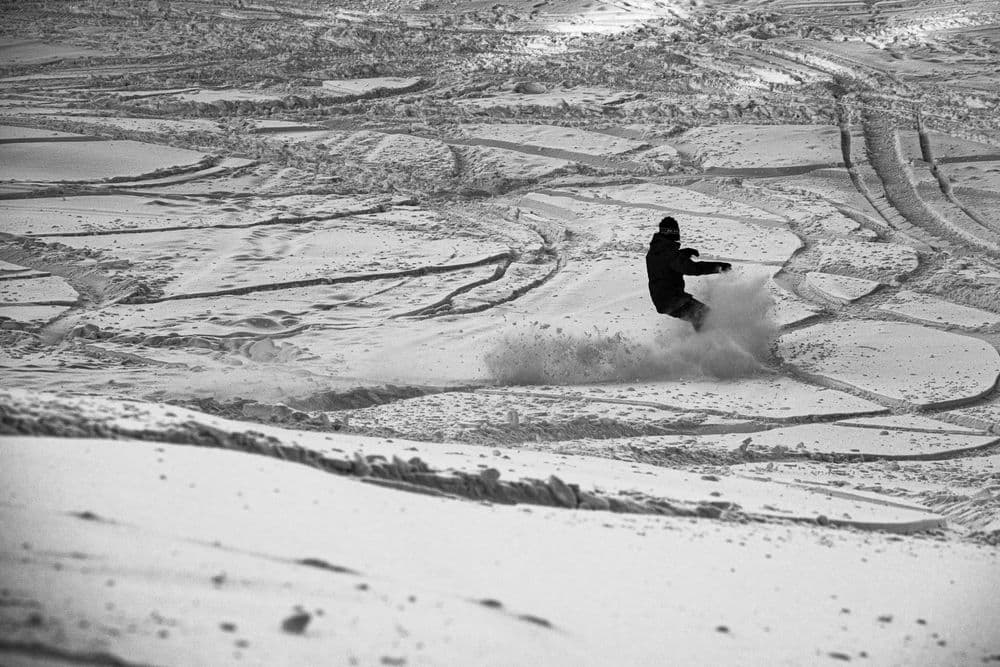
Width is a boot-size question
A snowboard is ridden across its width, with your boots pointing more or less perpendicular to the direction of travel. When the board is tipped on edge in a turn, anything that hangs over the edge can touch the snow - and a boot touching the snow mid-carve acts as a lever that pulls the edge out.
That is toe drag (or heel drag), and it is the entire reason wide boards exist. It is not about being tall or heavy. It is about the length of your boot against the waist width of the board.
| Boot size (US men's) | What you need | Why |
|---|---|---|
| Up to 10 | Standard width | Boot sits inside the edges at normal angles |
| 10.5 to 11 | Borderline | Angling the bindings a little more usually solves it |
| 11 to 12 | Wide | Overhang is enough to catch in a committed carve |
| 12 and up | Wide, and check the waist width figure | Some wides are barely wide |
Two things soften the rule. Modern boots have shrunk their outer shells relative to the foot inside, so a US 11 boot is not as long as it once was. And binding angles change the geometry: turning your feet outward a few more degrees tucks the toe and heel inside the edges, which is often enough at the borderline sizes. The stance and angles page covers how to set that up.
Length is a weight question
The old advice is that a board should reach somewhere between your chin and your nose. That is a rough proxy for height, and height is not what determines whether you can ride a board.
A snowboard turns because the rider flexes it. A light rider on a board that is too long or too stiff cannot bend it, so it will not turn however hard they try. A heavy rider on a board that is too short overpowers it and feels it wash out at speed. That is why makers publish a rider weight range for each length - and it is the single most useful number in the whole purchase.
- The Camp Seven Drifter publishes a rider weight range for every length, from 100 lb up past 250 lb, plus two wide lengths - which is the clearest published sizing data of any board on this site.
- The System MTN publishes eight lengths from 138 to 163 cm, two of them wide, which is an unusually broad run and useful for a household buying more than one board.
- The Camp Seven Redwood publishes five lengths including one wide option at 156 cm.
The snowboard size chart has the general bands, and the all-mountain roundup compares these boards on the rest of their published specs.
Women’s boards, and the width question in reverse
Boards sold as women’s are generally built narrower, on the reasoning that smaller boots need less width, along with a softer flex for lighter riders. The useful part is the flex: a lighter rider on a stiff board cannot bend it, which is the same failure as a board that is too long.
The trap is buying by label rather than number. A woman with a US 10 boot on a narrow women’s board has toe drag; a light rider of any description is better served by the published weight range than by the word on the graphic. The women’s board roundup compares the published specs rather than the marketing.
Reduced-footprint boots, and why the rule has moved
Boot makers have spent years shrinking the outer shell around the same internal volume, and the effect on this question is real: a modern US 11 can be measurably shorter than an older US 11, which is why advice written a decade ago pushes people onto wide boards they no longer need.
The practical consequence is that the boot in your hand matters more than the number printed on it. If you are between standard and wide, measure the outer sole of your actual boot rather than trusting a size-based rule - and if you are buying boots and a board together, buy the boots first.
Reading a spec sheet, and the number that is actually published
Board makers publish a waist width in millimeters for every length - the narrowest point of the board, measured between the edges at the middle. That is the figure the wide question turns on, and it is worth knowing how to read it.
| Published waist width | Usually labeled | Roughly suits |
|---|---|---|
| Under 250 mm | Narrow or women's | Up to about US women's 9 |
| 250-255 mm | Standard | Up to about US men's 10 |
| 256-259 mm | Mid-wide | About US men's 10 to 11 |
| 260 mm and over | Wide | US men's 11 and up |
Two cautions. Boot outer-shell length varies between makers, so a US 11 in one brand can be measurably shorter than a US 11 in another - which is why the carpet test earlier is worth more than any table. And a board labeled wide is not automatically wide enough: at size 12 and up, check the published number rather than trusting the label.
Where a maker publishes lengths but no waist figure - which happens on packages sold as complete setups - the wide options are usually flagged in the length list itself, as the System MTN does with two wide sizes in its published run.
Two adjustments for a beginner
- Take the shorter end of your weight range. A shorter board is easier to turn, easier to pivot when you are still skidding rather than carving, and more forgiving of mistakes. You can size up later; nobody ever wished their first board was longer.
- Prefer a forgiving profile. Rocker or hybrid profiles lift the contact points clear of the snow, which is the design decision that reduces edge catches - the thing that actually hurts and makes beginners quit. The shapes and profiles page explains the difference, and the beginner board picks are chosen on it.
If you are a heavier rider
Two things matter and they are separate. Length comes from the published weight range - go to the top of the run if you are at or past the upper band, because a board you overpower feels unstable at speed and washes out in a carve. And flex matters: a soft beginner board flexed by a heavy rider bottoms out, so a slightly stiffer board can feel easier rather than harder.
A heavier rider is also the person most likely to need a wide board, because boot sizes tend to run with body size. Check both numbers rather than assuming one implies the other.
Children and the growing-room temptation
Do not buy a child a board three sizes too long so it lasts. A child cannot flex a board built for an adult’s weight, so it will not turn, and a board that will not turn is a child who does not want to go again. Kids boards publish weight ranges exactly like adult ones - use them. The kids snowboard sizing page has the bands, and the kids board roundup compares what is published.
The buying checklist
- 1. Measure your boot, in US size, in the boots you will actually ride.
- 2. Decide standard or wide from that number, not from your height.
- 3. Find your weight in the published range for the model you want.
- 4. Take the shorter end if you are a beginner, the longer end if you are at the top of the band or ride fast.
- 5. Check the profile before the graphic. Package versus separates covers whether to buy it as a set.
The short version
Boot size decides width; published rider weight decides length. A board that is too wide for your boot feels sluggish edge to edge, and a board that is too narrow drags your toe into the snow mid-carve. Neither of those is a problem your height can tell you about.
Every pick, with the working
Each entry shows the published inputs, the axis scores they produce, and what you give up. The order is the computed order, not a commercial one, and the arithmetic is open underneath each score.
1 · A household buying more than one board
System MTN CRCX snowboard package
Eight published lengths from 138 to 163 cm is the widest size range in this category, which for a family means one brand can fit a twelve-year-old and a six-foot adult. The camber-rocker-camber profile is aimed squarely at not catching an edge.
- Published price
- Not published
- Cost per day on snow
- Not published
- Amortized over
- 5 seasons (25 days)
- Certified to
- Not published
- Published sizes
- 138 to 163 cm including two wide sizes
- Warranty
- No term published on the product page
System sells the MTN in several package configurations at different published prices, so no single list price applies to the item you will land on.
What it gets right
- Eight published lengths, two of them wide, which is unusually broad
- Camber-rocker-camber profile with the contact points lifted, designed to resist edge catches
- Sold as a complete package with bindings
What you give up
- No single published price: the same board appears in several package configurations
- Boots again separate
The working behind the 4.3
- Cost per day on snow: not scored
- No manufacturer-published price, so this axis is not scored.
- Published protection: not scored
- Snowboards carry no protective standard of their own.
- Size availability: 8.5
- 8 published sizes (8.5 of 8.5); no continuous adjuster published (+0); range: 138 to 163 cm including two wide sizes
- Warranty and support: 0.0
- no published term (0 of 6); no published crash replacement (+0); no published repair route (+0)
Axes with unpublished inputs are dropped and the remaining weights re-normalized, so a product is not punished for a manufacturer’s silence. Specifications compiled September 3, 2026 from System published specifications.
2 · An adult buying a first board who wants the size decision made by a number
Camp Seven Drifter snowboard with APX bindings
The only board package in this ledger that publishes a rider weight range against every single length, which turns choosing a size from a guess into reading a table. Camber-rocker-camber profile, Rockwell 48 steel edges, three-year warranty, bindings mounted.
- Published price
- $279.95
- Cost per day on snow
- $11.20 a day
- Amortized over
- 5 seasons (25 days)
- Certified to
- Not published
- Published sizes
- 153, 156, 158 wide, 159 and 163 wide cm, each published with a rider weight range from 100 lb to 250 lb and over
- Warranty
- Camp Seven 3-year warranty against manufacturer defects
What it gets right
- A published rider weight range for every length, from 100 to 250 lb and over
- Two wide lengths published, which is the fix for a boot size 11 and up
- Rockwell 48 fully wrapped steel edges and a dual-density poplar core, both published
- Three-year published warranty on board and bindings together
What you give up
- Shortest published length is 153 cm, so it starts above where a smaller adult should be
- Boots are separate, and boots are the part that has to be tried on
- An extruded base is slower than sintered when the snow is cold and dry
The working behind the 3.8
- Cost per day on snow: 2.8
- $279.95 over 5 seasons at 5 days each = 25 days = $11.20 a day
- Published protection: not scored
- Snowboards carry no protective standard of their own.
- Size availability: 6.8
- 5 published sizes (6.8 of 8.5); no continuous adjuster published (+0); range: 153, 156, 158 wide, 159 and 163 wide cm, each published with a rider weight range from 100 lb to 250 lb and over
- Warranty and support: 2.5
- 3 yr (2.5 of 6); no published crash replacement (+0); no published repair route (+0)
Axes with unpublished inputs are dropped and the remaining weights re-normalized, so a product is not punished for a manufacturer’s silence. Specifications compiled September 12, 2026 from Camp Seven published specifications.
3 · A first snowboard for an adult who has had a couple of lessons
Camp Seven Redwood snowboard with APX bindings
Rocker in the tip and tail, which is the profile that stops a beginner catching an edge, sold with bindings for $289.95. That is roughly three days of snowboard rental for two people.
- Published price
- $289.95
- Cost per day on snow
- $11.60 a day
- Amortized over
- 5 seasons (25 days)
- Certified to
- Not published
- Published sizes
- 149, 153, 156, 158 wide and 160 cm
- Warranty
- No term published on the product page
What it gets right
- Rocker zones at tip and tail, the construction that forgives a beginner's mistakes
- Bindings included, so the board arrives ready apart from boots
- Five published lengths including a wide option
What you give up
- Boots are a separate purchase and are the part that actually needs trying on
- A twin shape is a compromise for someone who will only ever ride one direction
The working behind the 3.0
- Cost per day on snow: 2.5
- $289.95 over 5 seasons at 5 days each = 25 days = $11.60 a day
- Published protection: not scored
- Snowboards carry no protective standard of their own.
- Size availability: 6.8
- 5 published sizes (6.8 of 8.5); no continuous adjuster published (+0); range: 149, 153, 156, 158 wide and 160 cm
- Warranty and support: 0.0
- no published term (0 of 6); no published crash replacement (+0); no published repair route (+0)
Axes with unpublished inputs are dropped and the remaining weights re-normalized, so a product is not punished for a manufacturer’s silence. Specifications compiled September 3, 2026 from Camp Seven published specifications.
Prices last verified October 19, 2026. Prices move constantly; the figure on Amazon at the moment you click is the real one.
Questions people actually ask
Do I need a wide snowboard?
If your boots are roughly US 11 and up, yes. Beyond that size the toe and heel of the boot hang far enough past the edges to touch the snow in a carve and lever the edge out - toe drag. Below US 10.5 a standard width is fine, and the sizes in between can usually be solved with more binding angle.
How do I know what length snowboard to buy?
Use the maker’s published rider weight range for each length rather than the chin rule. A board turns because you bend it, and weight is what bends it. Beginners should take the shorter end of the range they fall into.
Is the chin-to-nose snowboard sizing rule wrong?
It is a rough height proxy that ignores the variable that matters. Two riders the same height can be 60 pounds apart, and they need different boards. Every maker on this site publishes a weight range per length, which is a real specification rather than a rule of thumb.
What happens if my snowboard is too wide?
It feels slow and heavy edge to edge, because you have to tip a wider platform further to get the same edge angle. It is a comfort and responsiveness penalty rather than a safety problem, which is why you should only go wide if your boot size actually requires it.
Can binding angles fix toe drag?
At the margins, yes. Turning your feet out a few more degrees tucks the toe and heel inside the edges, and that is often enough at US 10.5 to 11. It will not rescue a genuinely too-narrow board under a size 12 boot.