Cross-country ski boots, and the sole standard that has to match
A nordic boot is only useful if its sole fits the binding on the ski. Three compared on what they publish, starting with the compatibility question.
By Sawyer V. · Published
We have not tested this gear. Everything below is compiled from published specifications and published safety standards, and the arithmetic is public so you can check it. This page carries affiliate links: if you buy through one we earn a commission at no extra cost to you, and it does not change the order of the picks. Full disclosure.
The short answer
Match the sole standard to the binding on the ski before anything else - a nordic boot with the wrong sole simply does not attach. Most modern touring skis use an NNN-type system binding; junior skis often use a T4 mono sole, which is not the same thing. Then buy on size run and published insulation, because a nordic boot is thin and your foot is not moving fast.
| # | Pick | Best for | Score | Price |
|---|---|---|---|---|
| 1 | Rossignol X1 Jr Kids Nordic Touring Boots A child on a nordic trail who needs to fasten their own boots | Not publishedon snow | 4.3/10 | $45.47 - View on Amazon |
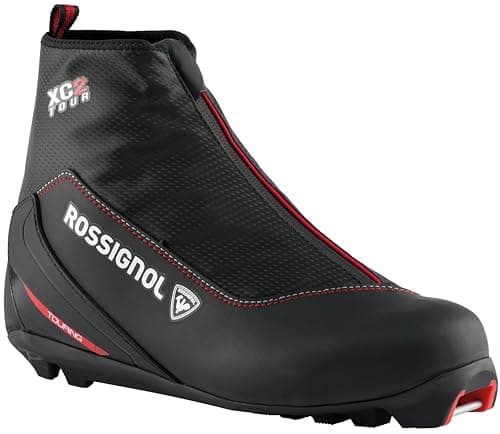
| 2 | Rossignol XC-2 Nordic Touring Boots An adult renting nordic skis for the third time and tired of rental boots | $12.00 a dayon snow | 3.3/10 | $116.97 - View on Amazon |
| 3 | Rossignol XC-2 FW Women's Nordic Touring Boots A woman whose rental nordic boots have always felt loose over the instep | $12.00 a dayon snow | 3.3/10 | $119.62 - View on Amazon |
Prices last verified October 19, 2026. Prices move constantly; the figure on Amazon at the moment you click is the real one.
The compatibility question, first
Downhill skiing settled on one boot-binding interface decades ago and you can put almost any alpine boot into almost any alpine binding. Alpine boots are sized in Mondopoint and fit almost anything. Cross-country did not do that.
A nordic boot attaches at the toe only, through a bar or a set of cleats in the sole, and there are several incompatible systems. The practical version for a family renting or buying entry-level gear:
- NNN-type system bindings are what most modern touring skis and most rental fleets use, including the packages covered on the packages page.
- T4 mono is a junior nordic sole. It is designed for children and it does not fit an adult touring binding.
- 75 mm three-pin is an older standard still found on backcountry and secondhand gear. If a ski has three pins at the toe, only a three-pin boot fits it.
What else to compare
- Size run. Nordic boots are sized in European numbers and the runs are narrower than alpine. A boot published in ten sizes fails more people than one published in fifteen.
- Published insulation. A nordic boot is thin - it has to flex at the ball of the foot - so unlike a ski boot it relies on actual insulation rather than a plastic shell. Very few makers name the material.
- Closure and snow protection. Laces alone let snow into the tongue on a track that is not perfectly groomed. A zip-up cover over the laces fixes it.
- Heat-moldable liner. Less common on nordic boots than alpine, and worth having when it appears.
The three, compared
| XC-2 | XC-2 FW | X1 Jr | |
|---|---|---|---|
| Sole standard | Touring sole, Tech Grip cleats | Sport sole, Tech Grip cleats | T4 mono (junior) |
| Published sizes | EU 35-49 (15) | EU 35-44 (10) | EU 26-41 (16) |
| Closure | Central zipper over laces | Zip-up lace cover | Hook, strap and speed lace |
| Insulation | Thermoadjustable polyester | 3M Thinsulate | Polyester lining |
| Heat moldable | Published | Published | Not published |
| Published price | $179.95 | $179.95 | US page retired; EUR 59.50 published |
The picks
Rossignol XC-2
The pick for most adults, on the size run alone. Fifteen published whole sizes from EU 35 to 49 is the widest run of any boot in this ledger, and on a nordic boot that matters more than anywhere else.
Here is why. Your heel is not attached to the ski. The only thing connecting you to it is a bar at the toe of the boot, so every bit of control travels through how well the boot holds your foot. A nordic boot that is half a size too large does not feel slightly loose - it means your foot moves inside the only fixed point you have.
A touring sole with central insert cleats, a central zipper over the laces so snow stays out of the tongue, a tall cuff, and a thermoadjustable liner a shop can heat mold. What it does not publish is an insulation material or a warranty term.
Rossignol XC-2 FW
The same money, and the only nordic boot on this page that publishes an actual insulation material: 3M Thinsulate, with a fleece-lined women’s liner.
It also publishes a reduced instep volume, which is the specification women’s boots usually claim in adjectives and rarely state. Instep volume is the right thing to reduce on a nordic boot: the foot lifts and flexes with every stride, and a boot with too much room over the instep lets the heel rise inside it.
The trade is the size run - ten published sizes against fifteen, EU 35 to 44. A woman with larger feet is better served by the unisex XC-2, which is the same price.
Rossignol X1 Jr
Marked as the skip above, conditionally. Across sixteen published sizes from EU 26 to 41, it is the cheapest boot in this whole ledger and by some distance.
Its closure is the reason it is here: a metal hook and a hook-and-loop strap over a speed lace, which is the only fastening on this page a six-year-old can operate unaided. A child who can put their own boots on is a child who gets out of the door.
The reason it is the skip is the T4 mono sole. It is the junior nordic standard, which means it fits junior skis and nothing else - no sharing, no handing sideways to a parent, no using it on rented adult skis. For a child who skis a nordic trail every weekend it is excellent value; for one who goes twice a winter, rent.
Which brings up the obvious question
Should you buy nordic boots at all? For a household that cross-country skis a handful of days a year, probably not - $179.95 is a lot of trail passes, and nordic rental is generally cheaper and more available than alpine rental.
The argument for buying is the same as for alpine boots and it is about fit rather than money: a rental fleet stocks the middle of the size range, and if your feet are at either end you get what is left. If you have ever spent a nordic afternoon with your heel lifting inside a rental boot, you already know the case. The rent-or-buy page on boots covers the alpine version of this argument.
The cheapest improvement
One thin wool sock. Nordic skiing is aerobic - you generate heat by moving, and a thick sock inside a thin boot compresses the air that does the insulating and makes your foot colder and sweatier at the same time.
The ski socks page explains the mechanism properly, and it applies even more to a nordic boot than an alpine one, because there is less shell around it to begin with.
And dry them properly afterwards. A nordic boot is thinner than an alpine boot and absorbs more, so it takes longer to dry and suffers more if you never bother. The overnight drying page covers doing it without cooking the glue.
Every pick, with the working
Each entry shows the published inputs, the axis scores they produce, and what you give up. The order is the computed order, not a commercial one, and the arithmetic is open underneath each score.
1 · A child on a nordic trail who needs to fasten their own boots
Rossignol X1 Jr Kids Nordic Touring Boots
Skip this one. Buy it only if the child has their own skis. It publishes a T4 mono sole, which is the junior nordic standard and does not cross over to an adult binding - so it cannot be shared, handed sideways, or used on a parent's skis. Across sixteen published sizes it is the cheapest boot here by a wide margin and genuinely good value for a child who skis a nordic trail regularly, and a waste of money for one who goes twice.
A metal hook and a hook-and-loop strap over a speed lace lock, which is the only closure on this page a six-year-old can operate unaided, across sixteen published sizes. The T4 mono sole is the junior nordic standard, so it matches the skis a school or rental fleet will hand over.
- Published price
- Not published
- Cost per day on snow
- Not published
- Amortized over
- 2 seasons (10 days)
- Certified to
- Not published
- Published sizes
- EU 26 through 41 in whole sizes
- Warranty
- No term published on the product page
Rossignol has retired the US product page for this boot; the live EU page publishes EUR 59.50 rather than a US MSRP, so no dollar list price is quoted and the cost-per-day axis is not scored.
What it gets right
- The cheapest boot in this ledger, by a wide margin, on live retail prices
- Metal hook plus hook-and-loop strap with a speed lace lock, operable by a child
- Sixteen published sizes from EU 26 to 41
- T4 mono sole, the junior nordic standard
What you give up
- T4 is not the adult NNN touring sole, so it does not cross over to a parent's skis
- No published insulation beyond a polyester lining
- No published warranty term
The working behind the 4.3
- Cost per day on snow: not scored
- No manufacturer-published price, so this axis is not scored.
- Published protection: not scored
- Boots carry no US protective standard, so this axis is not scored. On a winter boot the published temperature rating is the figure that matters; on a snowboard or nordic boot it is the sole standard and the fit.
- Size availability: 8.5
- 16 published sizes (8.5 of 8.5); no continuous adjuster published (+0); range: EU 26 through 41 in whole sizes
- Warranty and support: 0.0
- no published term (0 of 6); no published crash replacement (+0); no published repair route (+0)
Axes with unpublished inputs are dropped and the remaining weights re-normalized, so a product is not punished for a manufacturer’s silence. Specifications compiled October 18, 2026 from Rossignol published specifications.
2 · An adult renting nordic skis for the third time and tired of rental boots
Rossignol XC-2 Nordic Touring Boots
Fifteen published sizes from 35 to 49 is the widest range of any boot in this ledger, and on a cross-country boot that matters more than anywhere else because the boot is the only thing holding your foot to a ski that is not attached at the heel. Touring sole, central zipper over the laces, heat-moldable liner.
- Published price
- $179.95
- Cost per day on snow
- $12.00 a day
- Amortized over
- 3 seasons (15 days)
- Certified to
- Not published
- Published sizes
- EU 35 through 49 in whole sizes
- Warranty
- No term published on the product page
What it gets right
- Fifteen published whole sizes, EU 35 to 49, the widest run here
- Touring sole with central insert cleats published, which is the standard rental skis use
- Central zipper over the laces published, which is what keeps snow out of the tongue
- Thermoadjustable liner published as heat-moldable
What you give up
- No published warranty term
- No published insulation material, only a polyester thermoadjustable lining
- $179.95 is more than a season of nordic rentals in most places
The working behind the 3.3
- Cost per day on snow: 2.2
- $179.95 over 3 seasons at 5 days each = 15 days = $12.00 a day
- Published protection: not scored
- Boots carry no US protective standard, so this axis is not scored. On a winter boot the published temperature rating is the figure that matters; on a snowboard or nordic boot it is the sole standard and the fit.
- Size availability: 8.5
- 15 published sizes (8.5 of 8.5); no continuous adjuster published (+0); range: EU 35 through 49 in whole sizes
- Warranty and support: 0.0
- no published term (0 of 6); no published crash replacement (+0); no published repair route (+0)
Axes with unpublished inputs are dropped and the remaining weights re-normalized, so a product is not punished for a manufacturer’s silence. Specifications compiled September 12, 2026 from Rossignol published specifications.
3 · A woman whose rental nordic boots have always felt loose over the instep
Rossignol XC-2 FW Women's Nordic Touring Boots
The same money as the unisex XC-2 and the only nordic boot here that publishes an actual insulation material, 3M Thinsulate, plus a reduced instep volume. Reduced instep is the specification women's boots usually claim and rarely name, and it is what stops the foot lifting on a kick.
- Published price
- $179.95
- Cost per day on snow
- $12.00 a day
- Amortized over
- 3 seasons (15 days)
- Certified to
- Not published
- Published sizes
- EU 35 through 44 in whole sizes
- Warranty
- No term published on the product page
What it gets right
- 3M Thinsulate insulation published, the only named insulation of the three
- Published women's fit with reduced instep volume, not just a different color
- Zip-up lace cover published, which keeps snow out of the laces
- Thermoadjustable liner, heat-moldable at a shop
What you give up
- Ten published sizes against fifteen on the unisex version
- No published warranty term
- Same price as the unisex boot with a narrower size run
The working behind the 3.3
- Cost per day on snow: 2.2
- $179.95 over 3 seasons at 5 days each = 15 days = $12.00 a day
- Published protection: not scored
- Boots carry no US protective standard, so this axis is not scored. On a winter boot the published temperature rating is the figure that matters; on a snowboard or nordic boot it is the sole standard and the fit.
- Size availability: 8.5
- 10 published sizes (8.5 of 8.5); no continuous adjuster published (+0); range: EU 35 through 44 in whole sizes
- Warranty and support: 0.0
- no published term (0 of 6); no published crash replacement (+0); no published repair route (+0)
Axes with unpublished inputs are dropped and the remaining weights re-normalized, so a product is not punished for a manufacturer’s silence. Specifications compiled September 12, 2026 from Rossignol published specifications.
Prices last verified October 19, 2026. Prices move constantly; the figure on Amazon at the moment you click is the real one.
Questions people actually ask
Do cross-country ski boots fit all bindings?
No. Nordic boots attach at the toe through a bar or cleats and there are several incompatible systems - NNN-type on most modern touring skis, T4 mono on junior skis, and 75 mm three-pin on older backcountry gear. Check the binding on the ski before buying any boot.
How should cross-country ski boots fit?
Snug, with your heel held down and your toes able to move. Your heel is not attached to the ski, so the boot is the only thing connecting you to it - a boot half a size too large means your foot moves inside the one fixed point you have.
Are cross-country ski boots warm enough?
They are thinner than alpine boots because they have to flex at the ball of the foot, so they rely on real insulation rather than a plastic shell. Nordic skiing is aerobic, which generates heat - but if you stop a lot, look for a boot that publishes an insulation material rather than just a lining.
Can kids use adult cross-country ski boots?
Not usually, and the reason is the sole rather than the size. Junior nordic boots commonly use a T4 mono sole that does not fit an adult touring binding, so a child’s boots cannot be used on a parent’s skis or vice versa.
Should I buy or rent cross-country ski boots?
Rent if you ski nordic a handful of days a year - rental is cheaper and more available than alpine rental. Buy if your feet are at either end of the size range, because a rental fleet stocks the middle and you will keep getting whatever is left.