Ski boot flex: what the number means and which one to buy
Every boot publishes a flex number, no two brands measure it the same way, and buying a stiff one to grow into is the most expensive mistake in the category.
By Sawyer V. · Published
We have not tested this gear. Everything below is compiled from published specifications and published safety standards, and the arithmetic is public so you can check it. This page carries affiliate links: if you buy through one we earn a commission at no extra cost to you, and it does not change the order of the picks. Full disclosure.
The short answer
Flex is a number from roughly 60 to 130 describing how hard the boot resists bending forward. Beginners want 60 to 80; most recreational adults want 80 to 100. It is not standardized, so a 100 in one brand is not a 100 in another. And it should be matched to your weight and strength, not your ambition - a boot you cannot bend is a boot you cannot ski.
| # | Pick | Best for | Score | Price |
|---|---|---|---|---|
| 1 | Darn Tough Alpine Over-the-Calf Lightweight Ski Socks The one piece of ski gear worth buying before anything else | $2 a dayon snow | 6.4/10 | $30.95 - View on Amazon |
| 2 | Smartwool Ski Zero Cushion Over-the-Calf Socks A boot that already fits, where any extra bulk makes it worse | $1.93 a dayon snow | 5.9/10 | $30.00 - View on Amazon |
Prices last verified October 22, 2026. Prices move constantly; the figure on Amazon at the moment you click is the real one.
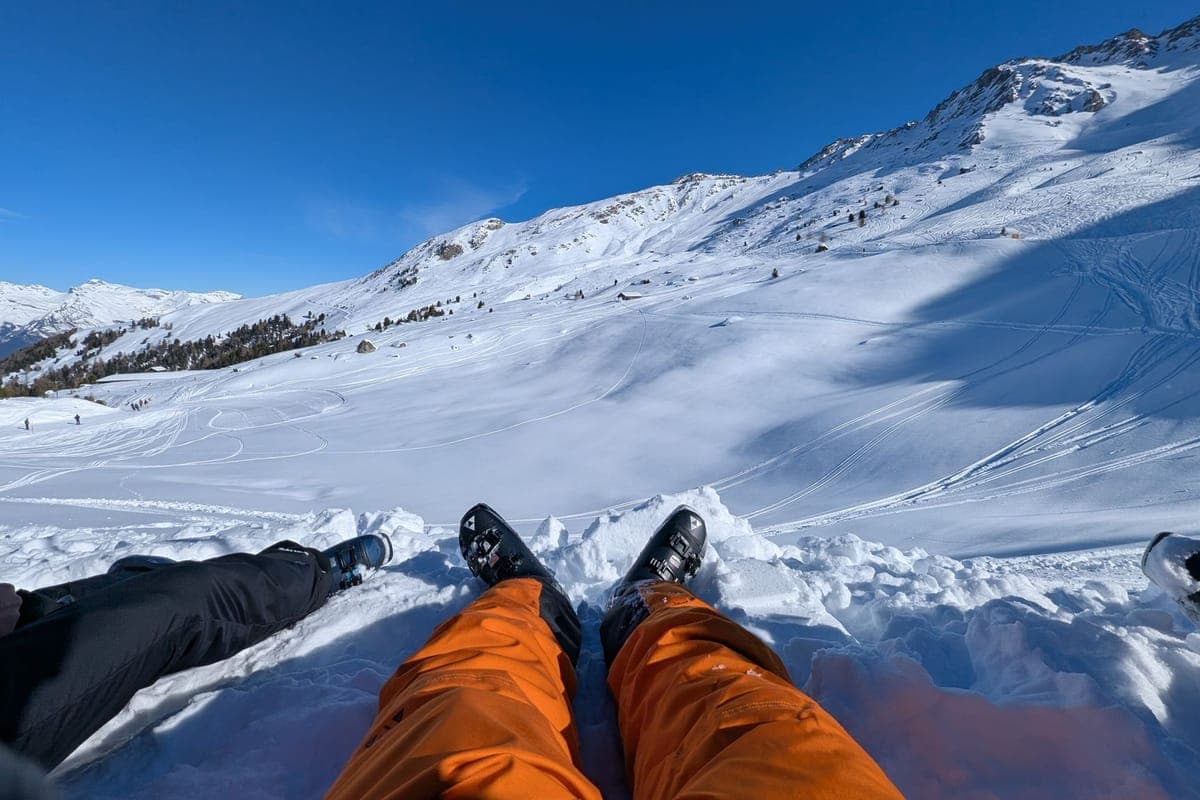
What flex actually describes
A ski boot is a rigid shell with a hinge at the ankle. Flex is how hard that hinge resists you pushing your shin forward into the front of the boot. A low number bends easily; a high number barely moves.
That matters because pressing forward is how you steer a ski. Leaning into the front of the boot puts pressure on the front of the ski, which is what makes it bite and turn. If the boot will not bend, that input never reaches the ski, and you end up sitting back and steering with your whole body instead - which is tiring, slow and the source of a great many aching thighs.
The published bands
| Flex | Feel | Suits |
|---|---|---|
| 50-60 | Very soft; bends with light pressure | Children, and very light adults |
| 60-80 | Soft; forgiving and easy to bend | Adult beginners, and lighter adults generally |
| 80-100 | Medium; the recreational default | Most adults who ski groomed runs comfortably |
| 100-120 | Stiff; requires real weight and strength to bend | Strong, fast, experienced skiers |
| 120+ | Very stiff; race and expert territory | A small minority of skiers |
Two adjustments to those bands matter more than ability. Weight: a heavier skier loads a boot harder, so the same flex feels softer to them. And height: a taller skier has a longer shin acting as a lever, which also makes a boot feel softer. A short, light adult and a tall, heavy one with identical technique want different numbers.
The mistake: buying stiff to grow into
It is the same instinct that makes people buy skis too long, and it fails for the same reason. A stiff boot does not make you a better skier who has to catch up to it. It simply refuses to respond until you can generate enough force to bend it, which for most people is years away and for some is never.
In the meantime the boot is doing active harm: because you cannot press forward, you learn to stand back, and standing back is the single most common technical fault in recreational skiing. A softer boot lets you learn the movement, and the movement is what you take with you when you eventually buy a stiffer one.
The same reasoning applies to skis, and the shapes page makes it there: buy for the skier you are now.
Teenagers and light adults: the specific problem
This is where flex goes wrong most often. A tall, light fifteen-year-old has a foot that fits an adult boot and a body weight that cannot bend the flex that adult boot is built around. The same is true of many smaller adults, who are frequently sold boots at a flex chosen for their foot size rather than their mass.
The fix is to shop on flex explicitly and to accept a number lower than the one that looks appropriate for their ability. A capable 60 kg skier is often better on a 70 flex than an 90, and a shop that pushes back on that is thinking about the boot rather than the person. The teen gear page covers the wider version of this sizing gap.
Fit comes first, always
Flex is the second question. The first is whether the boot fits, and no flex number rescues a boot that is the wrong shape or size for your foot. The order to shop in is: shell size, then shell shape, then flex, then everything else.
- Length, in mondopoint. Boots are sized in centimeters of foot length rather than shoe size, which is more precise and less familiar. The chart is here.
- Width, published as last width in millimeters. Typically 98 mm for narrow feet up to 104 mm for wide ones. This is the specification people miss entirely, and it matters more than flex for comfort.
- Volume through the instep. Not usually published, and the reason a shop fitting beats an online purchase.
- Then flex. Once the shell is right.
The boot buying guide covers the fitting process, and the rent-or-buy page covers whether to own them at all yet.
Flex is slightly adjustable
Not much, but enough to matter at the margins.
- The power strap. The wide velcro strap at the top. Tightening it firmly effectively stiffens the boot; leaving it loose softens it. This is the adjustment nobody uses and it is free.
- Buckle tension. The top two buckles change how much the cuff can move. Do not over-tighten - a boot buckled hard is a boot that restricts circulation, which is a leading cause of cold feet.
- A flex adjustment screw. Some boots publish one at the back of the cuff, giving two settings. Check whether yours has one; many people never notice it.
- Temperature. Plastic stiffens in the cold. A boot that felt right in a warm shop is stiffer at 10F, which is one more reason to size flex on the soft side.
The liner changes the flex over time
A new liner is firm and holds your leg positively. Over the first several days it packs out - the foam compresses to the shape of your leg and foot - and the boot both loosens and feels slightly softer.
Two consequences. When buying, prefer the boot that feels a touch too firm over the one that feels comfortable in the shop, because the comfortable one will be loose by the end of the season. And when an old boot starts to feel vague and you find yourself buckling harder, that is a packed-out liner rather than a worn-out boot - and a replacement liner is far cheaper than a replacement boot.
One thin sock, because it is part of the fit
Whatever the flex, the sock inside the boot is part of the system. One thin merino sock, never two, never cotton. Bulk fills space that should be filled by your foot, which makes the boot both looser and colder. The sock page makes the argument in full, and both socks in this ledger publish lifetime terms, which makes them the cheapest durable thing on the site.
Get the sock right, get the shell right, then pick a flex at the soft end of the band that suits your weight. That order produces a boot you can actually ski in, which is the only thing this page is trying to achieve.
Every pick, with the working
Each entry shows the published inputs, the axis scores they produce, and what you give up. The order is the computed order, not a commercial one, and the arithmetic is open underneath each score.
1 · The one piece of ski gear worth buying before anything else
Darn Tough Alpine Over-the-Calf Lightweight Ski Socks
The only item in this entire ledger with an unconditional lifetime guarantee. It is a $30 sock that the maker will replace forever, which over any realistic number of ski days is the cheapest thing on the site.
- Published price
- $30
- Cost per day on snow
- $2 a day
- Amortized over
- 3 seasons (15 days)
- Certified to
- Not published
- Published sizes
- S through XL
- Warranty
- Unconditional lifetime guarantee
What it gets right
- Unconditional lifetime guarantee, published without qualifying conditions
- Lightweight merino, which is correct for a modern ski boot: a thick sock makes boots colder, not warmer
- Over-the-calf length, so the boot cuff never touches bare skin
What you give up
- $30 for one pair of socks reads as absurd until the replacement policy is read
- Lightweight is the right choice but feels wrong to anyone expecting a thick ski sock
The working behind the 6.4
- Cost per day on snow: 9.6
- $30 over 3 seasons at 5 days each = 15 days = $2 a day
- Published protection: not scored
- Socks carry no protective standard, so this axis does not apply.
- Size availability: 5.1
- 4 published sizes (5.1 of 8.5); no continuous adjuster published (+0); range: S through XL
- Warranty and support: 2.0
- no published term (0 of 6); no published crash replacement (+0); repair or replacement parts published (+2)
Axes with unpublished inputs are dropped and the remaining weights re-normalized, so a product is not punished for a manufacturer’s silence. Specifications compiled September 3, 2026 from Darn Tough published specifications.
2 · A boot that already fits, where any extra bulk makes it worse
Smartwool Ski Zero Cushion Over-the-Calf Socks
Zero cushion is not a compromise, it is the point: in a boot fitted properly there is no room for padding, and every millimeter of sock is a millimeter of lost contact with the shell.
- Published price
- $28.95
- Cost per day on snow
- $1.93 a day
- Amortized over
- 3 seasons (15 days)
- Certified to
- Not published
- Published sizes
- S through XL
- Warranty
- Limited lifetime warranty
What it gets right
- Zero cushioning, which is the correct construction for a fitted ski boot
- Limited lifetime warranty published
- Merino blend, so it stays warm damp and does not smell after three days
What you give up
- The limited lifetime warranty is a narrower promise than Darn Tough's unconditional one
- Anyone whose boots are slightly too big will find zero cushion uncomfortable
The working behind the 5.9
- Cost per day on snow: 9.7
- $28.95 over 3 seasons at 5 days each = 15 days = $1.93 a day
- Published protection: not scored
- Socks carry no protective standard, so this axis does not apply.
- Size availability: 5.1
- 4 published sizes (5.1 of 8.5); no continuous adjuster published (+0); range: S through XL
- Warranty and support: 0.0
- no published term (0 of 6); no published crash replacement (+0); no published repair route (+0)
Axes with unpublished inputs are dropped and the remaining weights re-normalized, so a product is not punished for a manufacturer’s silence. Specifications compiled September 3, 2026 from Smartwool published specifications.
Prices last verified October 22, 2026. Prices move constantly; the figure on Amazon at the moment you click is the real one.
Questions people actually ask
What ski boot flex should a beginner buy?
Around 60 to 80 for an adult beginner, lower for a light adult or a child. A boot you cannot bend is a boot you cannot steer with, and it teaches you to stand back - the most common technical fault in recreational skiing. Buy for the skier you are now.
Is ski boot flex standardized between brands?
No. Each maker sets its own scale and the difference between brands can be substantial, so a 100 in one is not a 100 in another. Use the number to compare within a brand, and use fit and how the boot actually feels to compare across them.
Does weight affect what boot flex I need?
More than ability does. A heavier skier loads the boot harder, so the same flex feels softer to them, and a taller skier has a longer shin acting as a lever with the same effect. A short, light adult and a tall, heavy one with identical technique want different numbers.
Can you change the flex of a ski boot?
Slightly. Tightening the power strap firmly effectively stiffens the boot and leaving it loose softens it, and some boots publish a flex adjustment screw at the back of the cuff. Plastic also stiffens in the cold, which is a reason to size on the soft side.
What matters more, boot flex or boot fit?
Fit, by a wide margin. No flex number rescues a boot that is the wrong length, width or volume for your foot. Shop in this order: shell length in mondopoint, then last width in millimeters, then volume, then flex.