Ski racks, and the measurement to take before you order one
A roof ski rack clamps to crossbars, and the gap between your crossbars is a published requirement. Three compared on capacity, loading width and what each one locks.
By Sawyer V. · Published
We have not tested this gear. Everything below is compiled from published specifications and published safety standards, and the arithmetic is public so you can check it. This page carries affiliate links: if you buy through one we earn a commission at no extra cost to you, and it does not change the order of the picks. Full disclosure.
The short answer
Measure the gap between your crossbars first. Thule publishes a required spacing of 23 to 36.8 in across this entire range, and a rack that does not reach both bars is not a rack. Then buy on published capacity: the SnowPack M publishes 4 pairs of skis or 2 boards and the L publishes 6 and 4. The difference you feel is loading width - 19.6 in against 29.5 in - which is how much room you have to drop skis in with gloves on.
| # | Pick | Best for | Score | Price |
|---|---|---|---|---|
| 1 | Thule SnowPack M Ski and Snowboard Rack A family of four with skis, or two snowboarders with room to spare | $24.66 a dayon snow | 0.0/10 | $369.95 - View on Amazon |
| 2 | Thule SnowPack L Ski and Snowboard Rack Carpooling, or a mixed group of skiers and snowboarders | $28.00 a dayon snow | 0.0/10 | $368.78 - View on Amazon |
| 3 | Thule SnowPack Extender Ski and Snowboard Rack A tall vehicle, or skis with bindings that foul a low-mounted carrier | $38.00 a dayon snow | 0.0/10 | $569.95 - View on Amazon |
Prices last verified November 5, 2026. Prices move constantly; the figure on Amazon at the moment you click is the real one.
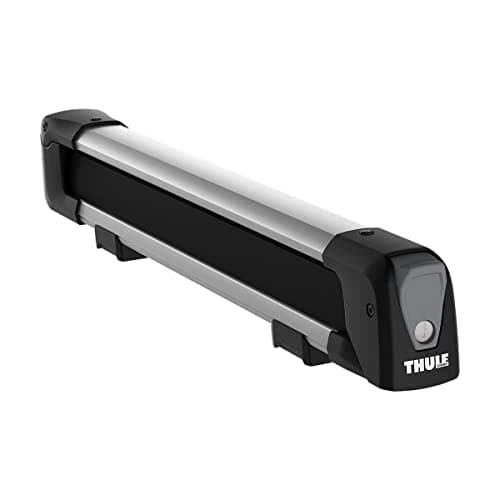
The measurement, before anything else
A roof ski rack does not attach to a roof. It clamps to two crossbars, and if you do not have crossbars you are buying a roof rack system first and a ski carrier second - which is a far larger purchase than the one you came here for. The car ski racks guide covers that decision in full.
What is new here is the number. Thule publishes a required crossbar spacing of 23 to 36.8 in on the M, the L and the Extender alike. That is a tape-measure job that takes thirty seconds in a driveway, and it is the single check that decides whether any of this fits your car.
Capacity, which is published honestly
This category states capacity as a number of pairs, and the numbers are meaningfully different rather than marketing rounding. A snowboard occupies roughly the space of two pairs of skis, which is why the board figure is always about half the ski figure.
The caveat Thule does not print: the published number assumes bindings, which take up most of the width of a ski. Four pairs of narrow carving skis fit a four-pair rack comfortably; four pairs of wide all-mountain skis with chunky bindings are optimistic. If your household skis wide, and the shapes page explains who does, size up rather than down.
What this page ranks on
- 1. Published crossbar spacing. A hard requirement, not a preference. 23 to 36.8 in across this range.
- 2. Published ski and board capacity. In pairs, which is the one number this category states plainly.
- 3. Published loading width. Underrated, and the thing you actually interact with. A 19.6 in carrier and a 29.5 in carrier hold different amounts, but they also feel completely different to load in gloves with cold hands and a child waiting.
- 4. What it locks, and whether the lock is in the box. There are two separate thefts to prevent - the skis from the rack, and the rack from the car - and makers are vague about which locks ship included.
- 5. Published maximum load. Rarely read and occasionally surprising, as the table below shows.
The three, compared
| SnowPack M | SnowPack L | SnowPack Extender | |
|---|---|---|---|
| Published skis | Up to 4 pair | Up to 6 pair | Up to 6 pair |
| Published boards | Up to 2 | Up to 4 | Up to 4 |
| Loading width | 19.6 in | 29.5 in | 29.5 in |
| Maximum load | 165 lb | 165 lb | 92.5 lb |
| Crossbar spacing | 23-36.8 in | 23-36.8 in | 23-36.8 in |
| Locks | Locks skis to carrier and carrier to bar; inclusion not stated | Locks skis to carrier and carrier to bar; inclusion not stated | One-Key system, locks published as INCLUDED |
| Published weight | 10.6 lb | 14.2 lb | 16.5 lb |
| Published price | $369.95 | $419.95 | $569.95 |
| Warranty term | Not published | Not published | Not published |
Two rows repay a second look. The maximum load row is the one nobody expects: the dearest rack in the range is published at 92.5 lb while the two cheaper ones are published at 165 lb. And the locks row is the one makers are slipperiest about - the M and L pages both say the rack “locks skis to carrier” and “locks carrier to roof rack” without ever stating that a lock or key comes in the box. Only the Extender says included.
The picks
Thule SnowPack M
The one most households should buy, and the reasoning is arithmetic rather than taste. Thule publishes 4 pairs of skis or 2 snowboards, which is a family of four with skis, or two snowboarders with room to spare. It is the lightest at 10.6 lb, which matters because you lift it onto the roof yourself, and at $369.95 published it is the cheapest of the three.
It publishes the same 165 lb maximum load as the L and the same 23 to 36.8 in crossbar spacing, so nothing about the car-fitting decision changes if you size down to it. Rubber arms grip the topsheets without marking them, and the carrier locks both the skis to itself and itself to the bar.
Honest cons. The 19.6 in loading width is the real trade - ten inches narrower than the L, which you notice every time you load two pairs side by side rather than one. Thule does not state whether locks are included, only that the rack is lockable, which is a distinction worth settling before you order. And no warranty term is published on the product page.
Thule SnowPack L
The one to buy if the household is bigger than the car suggests, or if anyone snowboards. Thule publishes 6 pairs of skis or 4 boards against the M’s four and two, and a 29.5 in loading width against 19.6.
That width is the reason to pay the extra fifty dollars even if you never carry six pairs. Loading a ski rack is a two-handed job done in gloves, usually in a car park, often with somebody waiting - and the difference between a nineteen-inch slot and a thirty-inch one is the difference between threading skis in and dropping them in.
Honest cons. 14.2 lb published, which is three and a half pounds more to lift onto a roof than the M. The same unstated lock inclusion. And the same caveat as every rack here: published capacity assumes bindings, so six pairs of wide skis with tall bindings is the optimistic end of that number rather than the comfortable one.
Thule SnowPack Extender
Marked as the skip above, conditionally - and the condition is your roof height rather than your ski count. Thule publishes a raised design for added roof clearance with tall bindings, and it is the only carrier in the range whose page states that the One-Key locks are included rather than leaving it implied.
On a tall vehicle that is a real argument. If you are reaching up and over the edge of a van roof rather than leaning across a wagon, a carrier that sits proud of the bars and opens where your hands actually are changes the job.
The reason it carries the skip is published in the same spec list: a maximum load of 92.5 lb against 165 lb on both cheaper racks, for $569.95 - a hundred and fifty dollars more than the L for the same published six pairs. It is also the heaviest at 16.5 lb, and Thule’s compatible-bar list for this model quietly omits ProBar, which the M and L both name. Check your bar before ordering this one specifically.
Why all three are Thule, and what that costs you
Because Thule publishes and its competitors would not let us read. We went looking for Yakima’s FatCat EVO and PowderHound to put a second brand on this page - both are in stock, both are legitimate racks, and the PowderHound in particular undercuts everything here on price. Yakima’s site rate-limited every automated read we attempted, and the one page that did load was its Canadian store, whose prices are in Canadian dollars.
So this page ranks what could be checked. That is a limitation and we would rather name it than quietly present a single-brand page as a survey of the category. If you are shopping beyond this page, the questions to ask any rack are the five above: crossbar spacing, capacity in pairs, loading width, what it locks, and the maximum load.
When a rack is the wrong purchase
- You do not have crossbars. Then this is a far bigger purchase than it looks, because a bar system costs as much again as the carrier. The guide covers what to check on your roof.
- You ski two or three times a winter. Skis fit inside most cars with a seat folded, and a padded ski bag costs a fraction of a rack and protects the gear from the car as much as the car from the gear.
- You need to carry luggage as well. A roof box swallows boots, bags and helmets alongside the skis. The roof box roundup compares those on published ski length, which is the figure that decides whether adult skis fit inside one at all.
- You are flying. None of this travels. The travel page covers what does.
Living with a rack
Two habits save money. Take it off in summer. A carrier left on the roof all year costs fuel every mile, collects road grime in the lock barrels and weathers for nine months to earn you three. And load bases down, tips back. Skis go on with the bases facing each other and the tips pointing rearward, which keeps the edges away from the paint and the tips out of the airflow.
One more, learned expensively by many people: write a note and put it where you will see it. Garage doors, drive-throughs and low car parks have ended more racks than theft has. The rack is taller than your car now, and your brain does not know that yet.
Fitting it, and the two mounting options on the box
Thule publishes both of these on every carrier in the range, and which one you use depends entirely on the bars you already have.
- T-Track. Thule and many aftermarket bars have a channel running along the top of them. The carrier bolts into that channel, which gives the cleanest fit and lets you slide the carrier along the bar to position it.
- Speed-Link around-the-bar. A clamp that wraps the bar from underneath. This is what you use on round bars, on most factory rails and on anything without a channel - which is to say, on most cars.
Neither needs tools beyond what comes with it, and neither is the hard part. The hard part is deciding where along the bars the carrier sits, because that position has to clear your tailgate when it opens, clear the sunroof if you have one, and leave room for anything else living on the roof. Do that with the car on level ground and the tailgate open, once, properly - it is far easier than discovering the clearance problem in a hotel car park in the dark.
And check the torque again after the first drive. Everything on a roof settles after a few miles of vibration, which is true of boxes as much as carriers.
Who should buy what
- A family of four with skis: the SnowPack M. Four pairs published, lightest to lift, cheapest of the three.
- Snowboarders, mixed groups or carpooling: the SnowPack L, and the extra ten inches of loading width is worth the fifty dollars on its own.
- A van or a tall SUV: the Extender, accepting the published 92.5 lb limit in exchange for a carrier you can actually reach.
- No crossbars, or two trips a winter: none of these. A ski bag and a folded seat.
Every pick, with the working
Each entry shows the published inputs, the axis scores they produce, and what you give up. The order is the computed order, not a commercial one, and the arithmetic is open underneath each score.
1 · A family of four with skis, or two snowboarders with room to spare
Thule SnowPack M Ski and Snowboard Rack
The size that fits a family: a published four pairs of skis or two snowboards, locking the gear to the carrier and the carrier to the roof bars. It is the middle of three published capacities and the one most households actually need.
- Published price
- $369.95
- Cost per day on snow
- $24.66 a day
- Amortized over
- 3 seasons (15 days)
- Certified to
- Not published
- Published sizes
- One size; published capacity 4 pairs of skis or 2 snowboards
- Warranty
- No term published on the product page
What it gets right
- Published capacity of up to 4 pairs of skis or up to 2 snowboards
- Locks the skis to the carrier and the carrier to the roof bars, which are two separate thefts to prevent
- Soft rubber arms published as gripping without scratching topsheets or bases
- Part of a published three-size range, so the capacity decision is made on a number rather than a guess
What you give up
- Requires roof bars you already own; the rack is not a complete roof system
- No published warranty term on the product page
- Published capacity is the limit with bindings, so four pairs of wide skis is optimistic
The working behind the 0.0
- Cost per day on snow: 0.0
- $369.95 over 3 seasons at 5 days each = 15 days = $24.66 a day
- Published protection: not scored
- This category carries no protective standard.
- Size availability: not scored
- Sold in one size, so size availability does not apply.
- Warranty and support: 0.0
- no published term (0 of 6); no published crash replacement (+0); no published repair route (+0)
Axes with unpublished inputs are dropped and the remaining weights re-normalized, so a product is not punished for a manufacturer’s silence. Specifications compiled September 12, 2026 from Thule published SnowPack specifications.
2 · Carpooling, or a mixed group of skiers and snowboarders
Thule SnowPack L Ski and Snowboard Rack
The large size, published at six pairs of skis or four snowboards. It is the right buy for a household that regularly carries other people's children, and the wrong buy for anyone whose roof bars are short — the rack has to fit across them before the capacity means anything.
- Published price
- $419.95
- Cost per day on snow
- $28.00 a day
- Amortized over
- 3 seasons (15 days)
- Certified to
- Not published
- Published sizes
- One size; published capacity 6 pairs of skis or 4 snowboards
- Warranty
- No term published on the product page
What it gets right
- Published capacity of up to 6 pairs of skis or up to 4 snowboards, the largest in the range
- Same published locking on both axes: gear to carrier, carrier to bars
- Soft rubber arms published as non-scratching
- One rack covers the mixed ski-and-board case that defeats a smaller carrier
What you give up
- Needs wide enough roof bars, and short factory bars are the common blocker
- More rack than a two-person household will ever fill
- No published warranty term on the product page
The working behind the 0.0
- Cost per day on snow: 0.0
- $419.95 over 3 seasons at 5 days each = 15 days = $28.00 a day
- Published protection: not scored
- This category carries no protective standard.
- Size availability: not scored
- Sold in one size, so size availability does not apply.
- Warranty and support: 0.0
- no published term (0 of 6); no published crash replacement (+0); no published repair route (+0)
Axes with unpublished inputs are dropped and the remaining weights re-normalized, so a product is not punished for a manufacturer’s silence. Specifications compiled September 12, 2026 from Thule published SnowPack specifications.
3 · A tall vehicle, or skis with bindings that foul a low-mounted carrier
Thule SnowPack Extender Ski and Snowboard Rack
Skip this one. Skip it unless you genuinely cannot reach your roof. It carries the same published 6 pairs as the L and costs $150 more, and the figure that should stop you is published right there on Thule's page: a maximum load of 92.5 lb against 165 lb on the M and the L. You are paying more for a rack that is rated to carry barely half as much, in exchange for a raised design and locks Thule states are included. On a tall van or an SUV with a roof you are reaching over rather than up to, that trade is real. On a wagon it is not.
The one that solves the problem nobody mentions until they own a rack: reaching it. Thule publishes a raised design for added roof clearance with tall bindings, and it is the only SnowPack whose page states that the One-Key locks are included rather than implied. The catch is published too - a maximum load of 92.5 lb against 165 lb on the M and L, for $150 more than the L.
- Published price
- $569.95
- Cost per day on snow
- $38.00 a day
- Amortized over
- 3 seasons (15 days)
- Certified to
- Not published
- Published sizes
- One size; published capacity 6 pairs of skis or 4 snowboards
- Weight
- 7484 g
- Warranty
- No term published on the product page
What it gets right
- Published 6 pairs of skis or 4 snowboards, the same capacity as the L
- Raised design published for added roof clearance with tall bindings
- The only SnowPack whose page states locks are INCLUDED, with the Thule One-Key system locking skis to rack and rack to bar
- Published 29.5 in loading width and the same 23-36.8 in crossbar spacing as the rest of the range
What you give up
- Published maximum load of 92.5 lb against 165 lb on the M and L - barely half, on the dearest rack in the range
- $569.95 published, $150 more than the L for the same published ski capacity
- 16.5 lb published, the heaviest of the three
- Thule's bar list for this model omits ProBar, which the M and L both name - check your bar before ordering
- No published warranty term on the product page
The working behind the 0.0
- Cost per day on snow: 0.0
- $569.95 over 3 seasons at 5 days each = 15 days = $38.00 a day
- Published protection: not scored
- This category carries no protective standard.
- Size availability: not scored
- Sold in one size, so size availability does not apply.
- Warranty and support: 0.0
- no published term (0 of 6); no published crash replacement (+0); no published repair route (+0)
Axes with unpublished inputs are dropped and the remaining weights re-normalized, so a product is not punished for a manufacturer’s silence. Specifications compiled November 4, 2026 from Thule published SnowPack Extender specifications.
Prices last verified November 5, 2026. Prices move constantly; the figure on Amazon at the moment you click is the real one.
Questions people actually ask
Do I need crossbars for a ski rack?
Yes. A roof ski carrier clamps to crossbars rather than to the roof itself, and Thule publishes a required spacing of 23 to 36.8 in between them across this whole range. If your car has no bars, budget for a bar system as well - it typically costs as much again as the carrier.
How many pairs of skis does a ski rack hold?
It is published as a number of pairs, which makes this category unusually easy to shop. The Thule SnowPack M publishes up to 4 pairs or 2 snowboards and the L publishes up to 6 pairs or 4 boards. The published figure assumes bindings, so wide skis with tall bindings sit at the optimistic end of it.
Do ski racks come with locks?
Read the page carefully, because makers are vague here. Thule's M and L pages both say the carrier locks skis to the carrier and the carrier to the roof bars, and neither states that a lock or key is in the box. Only the SnowPack Extender page says locks are included. There are two separate thefts to prevent and they are not always covered by the same part.
What is loading width and why does it matter?
It is how wide the carrier opens, and it decides how easy loading actually is. The SnowPack M publishes 19.6 in and the L publishes 29.5 in. Capacity tells you how much fits; loading width tells you how it feels to put it there, in gloves, in a car park, with somebody waiting.
Can I leave a ski rack on all year?
You can, and it costs you. A carrier left on the roof burns fuel every mile, collects road grime in the lock barrels and weathers through nine months of non-use to serve three. Taking it off at the end of the season is twenty minutes that pays for itself.
Is a ski rack or a roof box better?
A rack is cheaper, lighter and quicker to fit, and carries only skis and boards. A box carries skis plus boots, bags and helmets, and is the better answer for a family driving to a week away. The box figure to check is the published maximum ski length, because plenty of boxes will not take an adult ski at all.
Sources
- Thule published SnowPack M specifications: up to 4 pair of skis or 2 boards, 19.6 in loading width, 165 lb max load, 23-36.8 in crossbar spacing, 10.6 lb, $369.95
- Thule published SnowPack L specifications: up to 6 pair of skis or 4 boards, 29.5 in loading width, 165 lb max load, 14.2 lb, $419.95
- Thule published SnowPack Extender specifications: up to 6 pair of skis or 4 boards, 29.5 in loading width, 92.5 lb max load, One-Key locks included, 16.5 lb, $569.95